



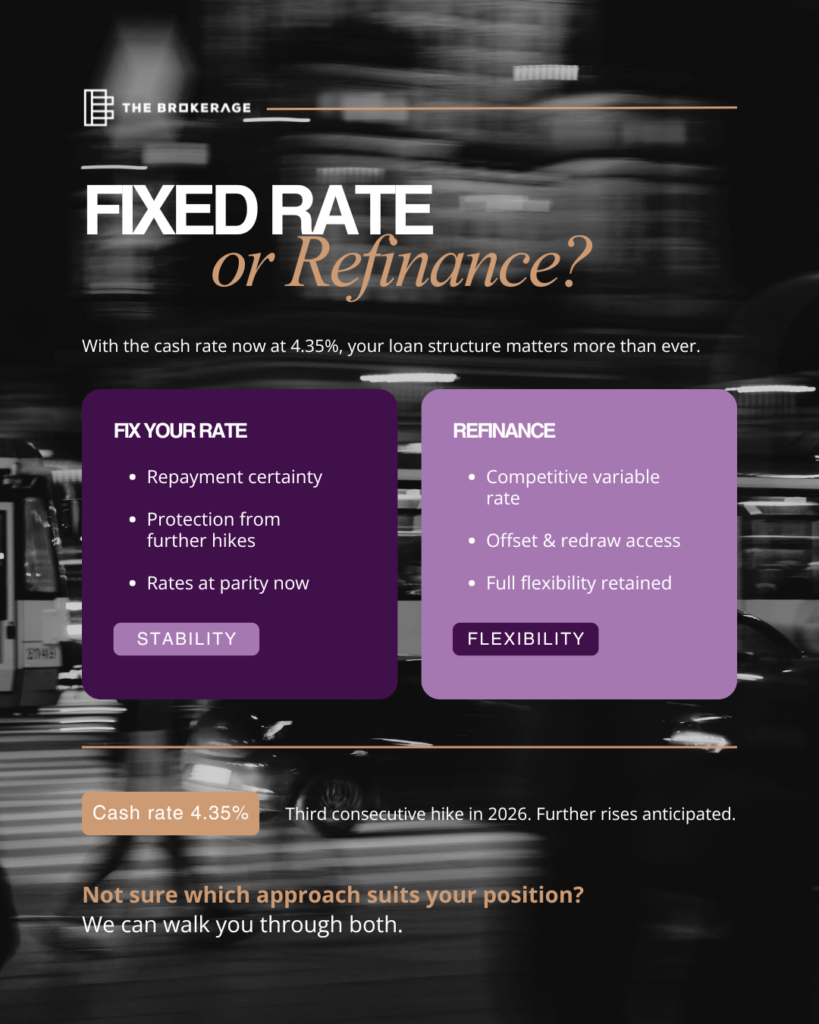
The RBA’s decision to lift the cash rate to 4.35 per cent on 5 May marks the third consecutive hike in 2026, reversing all three of the cuts borrowers benefited from last year. With lenders passing the increase on to variable rate customers from 15 May, and further hikes still on the table, the question I am hearing most often right now is a simple one: what should I actually do?
There are two main strategic responses available to borrowers in this environment. The first is refinancing. The second is moving to a fixed rate structure. Both have genuine merit depending on your circumstances, and understanding the difference between them is the starting point for making a good decision.
What Refinancing Offers
Refinancing means replacing your current loan with a new one, either with your existing lender or a different one. It can reduce your interest rate, change your loan structure, unlock equity, or simply move you to a product that better suits where you are now.
In a rising rate environment, refinancing to a more competitive variable rate can still deliver meaningful savings, particularly if you have been sitting with the same lender for several years without reviewing your position. Lenders regularly offer sharper rates to new customers than they extend to existing ones, and many borrowers are paying more than they need to simply because they have not had that conversation recently.
Refinancing also preserves flexibility. Variable rate loans typically allow unlimited additional repayments, access to offset accounts, and the ability to redraw funds when needed. For borrowers who value the ability to move quickly or pay down their loan faster, that flexibility has real value.
The limitation of refinancing in the current environment is that it does not provide certainty. If rates continue to rise, a more competitive variable rate today may still be higher in three or six months’ time.
What Fixing Your Rate Offers
A fixed rate home loan locks in your interest rate for a set period, typically one to five years, regardless of what the RBA does in the meantime. Your repayments stay the same for the duration of the fixed term, which makes budgeting significantly more straightforward.
Fixed rates have reached parity with variable rates and are currently sitting broadly in the mid-5 to low-6 per cent range across the market. That parity matters. Historically, fixed rates have carried a premium over variable rates because borrowers were paying for certainty. Right now, that premium has largely disappeared, which means fixing your rate is a more attractive proposition than it has been for some time.
The trade-off is reduced flexibility. Most fixed rate loans cap additional repayments, and breaking a fixed rate contract before the term ends can result in significant break costs. For borrowers who may need to sell, access equity, or restructure their loan during the fixed period, that is an important consideration.
A shorter fixed term of one to two years offers protection from near-term rate increases while keeping future options open, which may suit borrowers who believe the current hiking cycle will eventually reverse. A longer fixed term of three to five years provides greater certainty but carries the risk of being locked in above market rates if conditions improve.
The Case for a Split Loan
For many borrowers, the most practical answer sits somewhere in the middle. Splitting a home loan into fixed and variable portions allows you to benefit from the certainty of fixed repayments on one portion while retaining the flexibility and features of a variable rate loan on the other. The proportions are yours to determine, and the right split will depend on your cash flow needs, your appetite for risk, and your longer-term goals.
It is not a perfect solution, but in an environment where rate direction remains genuinely uncertain, it is often the most sensible one.
What Should You Do?
The honest answer is that it depends on your individual position, and anyone who tells you otherwise is giving you advice that has not been properly thought through.
What I would encourage you to do is treat the current environment as a trigger to have the conversation, not a reason to panic. Rates have moved quickly, but the right response is a structured one. Review where you are sitting now, understand what your options look like, and make a decision based on your actual circumstances rather than the headline.
If you would like to talk through your position, we are here. Contact Us today.
Source: Money.com.au